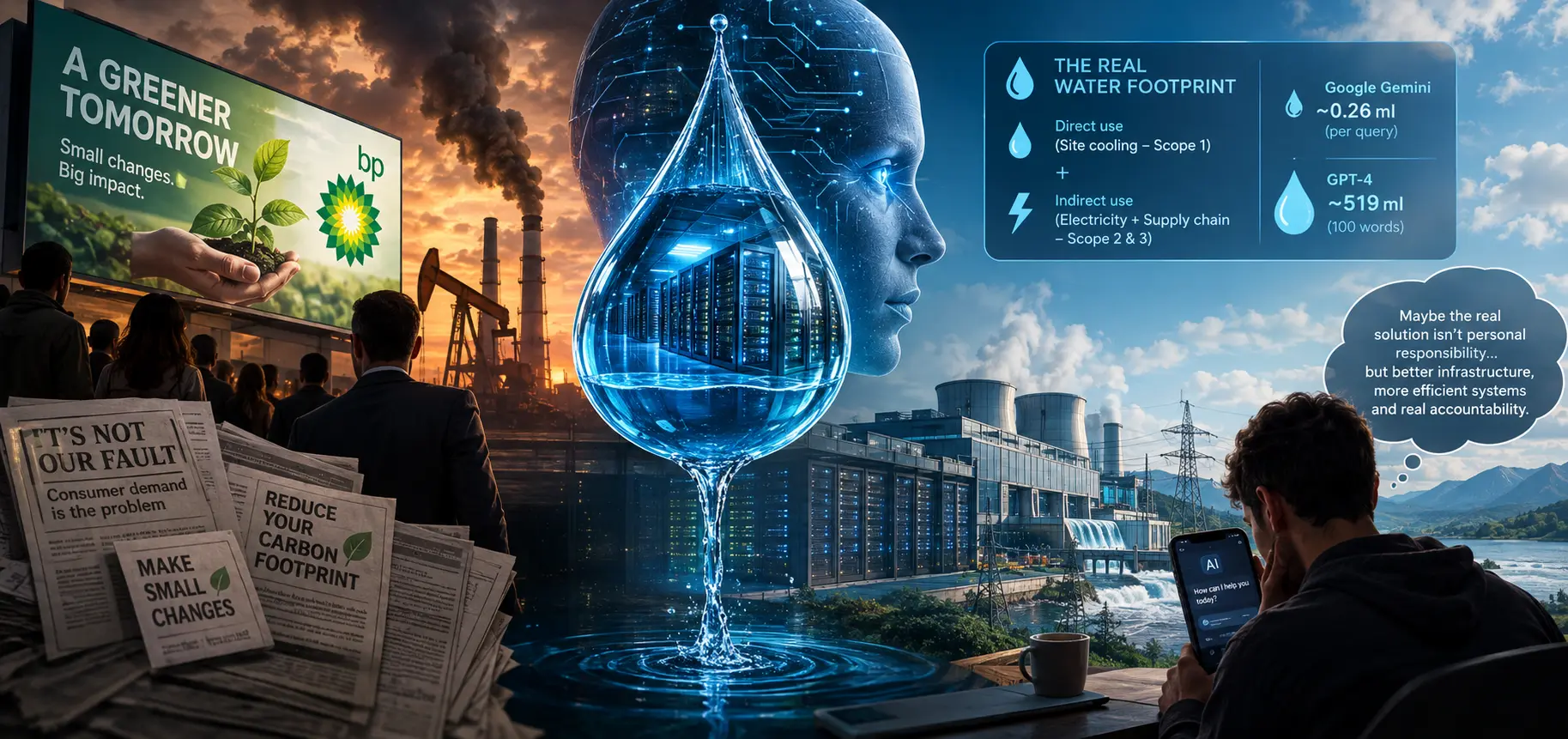
It is an undeniable scientific fact that artificial intelligence (AI) technologies, particularly large language models (LLMs), consume enormous amounts of water and energy during training and operation. Yet in many current discussions about water consumption in the age of superintelligence, the burden of these massive environmental costs is placed on ordinary users, software developers, and researchers who use AI in their daily lives.
Consumers are advised to 'combine your prompts,' 'avoid unnecessary AI usage,' or 'choose smaller models.' This approach is little more than an attempt to divert attention from the problem by individualizing responsibility, rather than requiring technology companies to take ownership of the inefficient infrastructure they have built.
This public relations strategy is nothing new. Modern technology companies are copying a tactic pioneered by fossil fuel giants two decades ago—one of the most successful forms of blame-shifting in industrial history. To understand the real origins of the problem and its technical dimensions, we must first examine the troubling history of the carbon footprint concept, then evaluate academic research and corporate data on AI water consumption through the lens of transparency.
The Anatomy of Blame-Shifting: The Fossil Fuel Industry's Masterstroke
One of the architects of the strategy of shifting corporate responsibility for the climate crisis onto individuals was British Petroleum (BP), one of the world's largest oil companies.
In the early 2000s, facing public pressure and the threat of regulatory action, BP launched a $200 million campaign with the public relations agency Ogilvy & Mather. The company adopted the slogan 'Beyond Petroleum' and published what it presented as the world's first carbon footprint calculator on its website in 2004.
This move shifted the focus of the climate change debate away from massive oil refineries and corporate profit-seeking toward the idea that ordinary people—those who drive to work, use plastic bottles, or heat their homes—needed to adopt a personal 'carbon diet.'
Economic and independent scientific analyses suggested that structural transformations, including investments in renewable energy and infrastructure modernization, could be financed through relatively modest sacrifices of around 2–3% of these energy giants' revenues or profit margins. Yet these realities were drowned out by the green-themed advertising noise generated by enormous PR budgets, with messages such as 'ride a bicycle' and 'change your light bulbs.'
Meanwhile, BP reportedly continued to allocate only 2.3% of its budget to renewable energy while advising individuals to reduce their carbon footprints.
Academic research has also documented this kind of manipulation. Harvard University researchers Geoffrey Supran and Naomi Oreskes examined ExxonMobil's communications between 1977 and 2014. Their research found that the company acknowledged climate science in its internal communications while systematically downplaying climate risks in public-facing advertorials and shifting blame toward consumer demand for fossil fuels—a strategy described as 'demand-as-blame.'
The narrative technology giants are now developing around AI water consumption follows the same playbook, adapted for the digital age. Infrastructure costs and design shortcomings are pushed into the background, while individual restrictions on prompts are brought to the forefront.
AI's Real Water Footprint and the Illusions of Measurement
There is a substantial gap between the data presented by companies and the findings of academic research on AI water consumption. A study by UC Riverside researcher Shaolei Ren, titled Making AI Less Thirsty, highlights a critical issue: the environmental cost of an AI query depends on what is actually included in the calculation.
When communicating with the public, technology companies often report only direct, on-site cooling water use, while overlooking the water used to generate electricity and throughout the hardware supply chain.
For example, Google has stated that an average Gemini query consumes only 'five drops' of water—approximately 0.26 milliliters—at the data center. However, when electricity generation is included in a full life-cycle assessment, the total water footprint of generating a 100-word response with an advanced model such as GPT-4 has been estimated at approximately 519 milliliters, nearly an entire standard half-liter bottle of water.
Research suggests that indirect water consumption can be roughly twelve times greater than direct consumption. From this perspective, the 'five drops' argument risks concealing most of the environmental cost rather than presenting the complete picture.
Corporate-level figures show the scale of the problem: Microsoft reported 6.4 billion liters of direct water use in 2022 (a 34% increase), Google reported 19.5 billion liters (20% increase), and Meta reported 3.1 billion liters in 2023.
Training a single large language model like GPT-3 can cause approximately 700,000 liters of freshwater to evaporate. By 2028, annual on-site water consumption by data centers in the United States alone is projected to reach between 150 billion and 280 billion liters.
Conclusion: Environmental Responsibility Must Start at the Infrastructure Level
As we move toward the age of superintelligence, the water and energy costs of technological progress are undeniable.
However, attempting to place these costs on the shoulders of ordinary people who use AI for personal or professional purposes continues a harmful corporate strategy successfully employed by companies such as BP and ExxonMobil for decades.
Users should not have to feel guilty every time they submit a prompt.
The environmental bill should instead be directed toward technology giants that hesitate to invest even a small percentage of their enormous profits in closed-loop cooling systems, build data centers in drought-stricken regions in pursuit of cheaper resources, and spend millions on public relations campaigns that obscure the full operational reality.
Individual conservation has a place, but it cannot substitute for systemic reform.
Real environmental sustainability will not be built through individual restrictions alone. It will be built through transparent reporting, accountable infrastructure decisions, enforceable regulation, and engineering solutions that address the problem at its source.
The question is not simply how much water an individual AI prompt consumes. The more important question is why the infrastructure powering the AI revolution is designed, located, and operated in ways that make such enormous resource consumption necessary—and who should be held accountable for changing it.